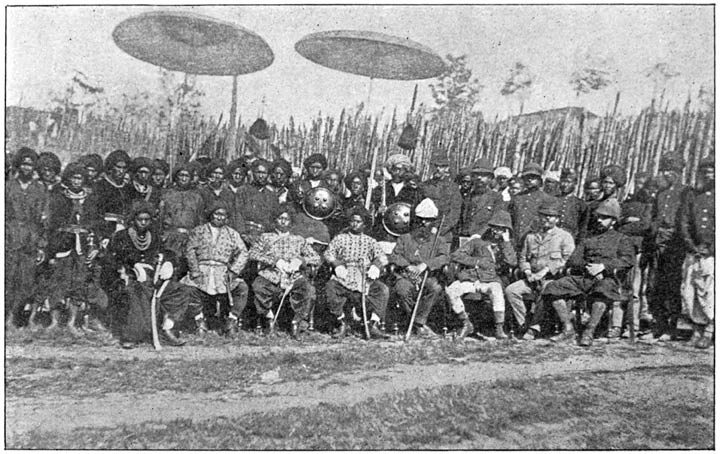
In 1879, Naga peace
missionary came to Manipur for friendship and fight against the British. The
two neighbours need the same mission in 2016.
This time for peace and development in the region. Time is perfect to remember
old ties and open for new partnership. The Naga Peace Accord will not
bear much success if Manipur, major stakeholders of the process is not
consulted.
Manipur never wanted to disturb the affairs of neighboring States or Kingdoms
and present generations are not interested to meddle with the political issues
of Nagaland.
In early days too, Manipur did not interfere in the affairs of Naga Hills after
the expedition in 1833. This was mainly due to a Treaty of Non
-Interference Policy signed between British India and King of Manipur in 1851.
British first encounter the Nagas in 1832 when Meetei King Gambhir Singh, along
with two British officers Captain Jenkins and Pemberton was looking for a
passage through the hills to enter Assam plain around the Lakhimpur and
Sibsagar area.
In the early parts of the 19th century, Burmese invaded, Naga Hills, Assam and
Manipur. Manipur defended the region and drive out the Burmese in 1825. British
took over the administration of Assam in 1830. After British controlled Assam,
the Angamis and Zeliangrongs frequent raids in North Cachar and some
parts of Manipur in the North.
Similarly, the Lothas, Ao, Phom and Konyak carried out raids in North Western
side of Manipur and Assam. The main purpose of raids was to capture people to
sell as slaves.
After signing the Anglo-Manipur alliance treaty of 1833, British know that
Maharaj Gambhir Singh of Manipur had in mind the permanent conquest of Naga
Hills. The Southern part of Naga Hills was controlled by Manipur.
The Nagas regarded Manipur was the stronger power of the two alliances (Manipur
and British). When Nagas turned down the ultimatum of British in 1833, Gambhir
Singh marched upto Kohima and other Angami villages. He re-asserted the
authority of Manipur over that area and reduces to submission several villages
including Kohima.
|
Meetei
King Gambhir Singh erected his footprints engraved at a Stone in Kohima
(Thibomei) in 1833 (Image credit - RKCS/Google Image)
|
At Kohima, the Maharaj footprint engraved on a stone was erected as a symbol of
conquest on 10 February, 1833. The Nagas respect this stone and clean it from
time to time.
In 1850-51, number of Meetei had close relations with a number of Nagas
(particularly Angamis). The joint neighbors demanded Manipur's rightful throne
to Maharaj Chandrakirti Singh and Kabaw valley compensation to him.
Whenever a Meetei visited a Naga Village, he was treated as an honoured guest,
at a time when a British subject could not venture into the interior without
risk of being murdered. After the death of Maharaj Gambhir Singh in September
1834, The Nagas became free from the tribute systems to Manipur.
The Naga Hills District was formed in 1866 and the first boundary of the Naga
Hills District was notified in 1867 with Samagudting as first District
Headquarters.
Very soon, the Nagas came to realise about the British Divide and rule policy
among the people of Manipur and Naga Hills as Hillsman and Plainsman.
Then, the Naga Hills started its independent movement in 1879. At this time,
Manipur had no intention to annex the Naga Hills to its Country. Manipur
desired to live at peace with the people of Naga Hills.
The Nagas came to Maharaj Chandrakirti Singh to fight war against the
British. Though aid was not openly given by the King of Manipur, no doubt
the Meetei helped the Angamis. British found out that the attacks against them
in Naga Hills were always made by Meetei factions who don’t want alliance with
the British. In every Angami village there were two parties, one attached to
the interest of Manipur and other to the British.
Manipur had its firm foot that it was to live peacefully to its original
political sovereignty. The Political consensus of Manipur was for a peaceful
co-existence with its neighbourhood.
While final decision to make the Naga Hills a British district was taken in
1881. Naga Hills within the administered area consisted of more than eight
tribes, quite different from one another, quite different in languages which
could not be understood by each other. There was no unity among the Nagas, It
was only the Anglo Manipuri alliance that was holding the Naga together.
|
 |
Meetei Warriors along with British after defeating Naga Hills in 1880.
|
|
Thus the newly created District of British India lies between 25o2’ and 26o47’N
and 98o17’ and 94o52’ E and covers an area around 8600 square miles; on the
west by Sibsagar, Nowgong and the north Cachar Hills; on the South by the
Princely state of Manipur; and on the east by the mountain ranges inhabited by
independent Naga tribes.
The outbreak of Naga war of 1879 and the revolution in Naga Hills was a
watershed in the political history of Naga Hills.
Far sighted Britishers started a policy of dividing Naga Hills and
Manipur after defeating the Naga Hills in 1880 and Manipur in 1891.
They feared that Manipur and Naga Hills could be united and act against the
British. The British felt alarmed the possibility of alliance between Manipur
and Naga Hills and various measures were done to check the free flow of both
neighbours, successful to some extent. For example, the Inner Line Regulation
Act.
Of the two neighbours, the first movement against British was occured in
Manipur in the form of First Nupi Lan (Women's war) in 1904 and Second Nupi Lan
in 1939. In Naga Hills, the First World war veterans formed the Naga Club
in 1918. However, this was not against the British. It was, however, the
harbinger for a Naga Nationalism.
When Naga National Council (NNC) was formed in 1946, consisting of various
Nagas and Kukis in the Naga Hills District, the main policy was to safeguard
Naga's interests after British left India. Series of movements continued under
the able leadership of Angami Naga, A Z Phizo who sowed the seed of Naga
Country.
NNC itself is a united representatives of various Naga communites and symbols
of each Naga are seen in the group. The Highest and must respected "Naga
Parliament" came to be known as "Tatar Hoho" after the
Sema, Lotha and Ao word for "Village elders" (tatar) and the Lotha
and Sema word for Assembly " Hoho". Rengma word for king or
supreme head "Kedahge" was used for "President" of the
Federal Government of Nagaland. The Yimchunger word for village Councillor was
used to represent Ministers as "Kilonsers".
Such combination of different communities shows Naga Nationalism are for the
whole Nagas who have been fighting since 1832 till today.
To wage war against the colonial Indian forces, the first major contigent of
150 Naga rebel troops touched the Naga soil in 1962 from East Pakistan (now
Bangladesh).
While in Manipur, Hijam Irabot formed the "Independent Peasant
Republic" and its armed organisation, the Red Guards was formed in
March 1950. However, the first Meetei revolutionary movement died with Irabot
in 1951.
Later, another movement came up on 24 November 1964, termed as the
"unfinished revolution of 1948", the United National
Liberation Front (UNLF) headed by Arambam Samarendra to liberate Manipur from
Indian colonial occupation in the larger context of liberating the entire
Indo-Burma region for a Common future.
Like the NNC, UNLF too is a composite body of various ethnic communities in
Manipur, particularly, the Kukis and Kabuis who belive in a united force to
fight against the Indian Occupational Force. Arambam Samarendra was successful
in joint struggle with the Thadou and Kuki Chin movements. He was dreaming for
a Pan Mongoloid movement to include all Mongoloid people of Indo-Burma region.
Unfortunately, UNLF mission to the Naga Hills was obstructed, may be time was
not ripe or communication gap between the leaders. Samarendra went to Kohima to
meet NNC leader, Imkongmeren Ao, who was the Vice President of NNC. Not only
the meeting for a unified force was a failure, but it was unfortunate in the
history of two neighbours, Naga Hills and Manipur.
Lungshim Saiza, a Tangkhul leader who married to one of the niece of A.Z.Phizo not
only made derogatory remarks against Meetei, but he was reported to have
told the visiting Meetei leaders in Naga Hills to meet the "Nagas only
when the time's ripe"!